Is there anything more exciting than planning your homeschool year and picking out new studies for your children? As you compile a list of what your family will learn in the upcoming year, have you ever wondered if your list is too long or how you are going to fit it all in?
In this blog post I am sharing all the details on a trick I’ve used over the years to fit everything in without making homeschool feel burdensome. To add in multiple subjects we love, we use a loop schedule, a system I have used for years in my homeschool. A loop schedule helps add variety to our schedule without getting stressed or overwhelmed if things gets interrupted.
Read why a loop schedule works for my family, how we use it, and frequently asked questions I get about a loop system. I also included a free Loop Scheduling Template (Printable PDF) for you to make your own loop list for the upcoming school year.
In this blog post:
- What is a loop schedule?
- Benefits of the homeschool looping method: Why parents love it
- Types of loops you can create
- Real-life loop scheduling examples
- FAQs about loop scheduling
- Free Printable PDF: Loop Scheduling Template
What is a loop schedule?

Loop scheduling is a homeschool planning method where you go down a list of subjects in order, one per day, in the time slot your daily rhythm allows for. Instead of a checklist for each day, or doing every subject every day, a loop system pulls from a selection of subjects you rotate through in the amount of time you have. With this method, you can simply rotate through subjects as your schedule allows without the stress of having to do every study each day you homeschool.
Many homeschool families do their core curriculum each day, and use a loop schedule it add in other academic work or enrichment studies in a loop time block.
Benefits of the homeschool looping method: Why parents love it

One benefit of homeschooling is being able to incorporate studies you love, or add in what you want your children to learn. But once you start browsing homeschool curriculum or enrichment activities, you may start feeling like you have a long list of subjects you want to cover. It can be overwhelming to step into each homeschool day knowing you have a long list of exciting things to learn. You may feel like you simply can’t get through it all, or if something disrupts your schedule, the whole system is thrown off.
A loop schedule offers a nice alternative for parents who want to include variety in their homeschool and offer children several different studies or activities. With a loop schedule, you designate studies or activities you want to rotate through and work through them in the time you have. If your child is sick or you have an appointment on your calendar, you don’t have to worry about missing the study you do every Tuesday. You can just pick up the next day where you left off.
The homeschool looping method is a nice middle ground between incorporating a variety of subjects you love and having the pressure to do everything daily.
Types of loops you can create
Here are the main loop systems we have enjoyed using over the years.
Morning Time Loop

I love gathering my children together for Morning Time to start our day. For our family, morning time has always been the time we gather together to begin our homeschool day.
Here are some subjects we have included in our Morning Time Loop over the years:
- Bible and Scripture Memory
- Character Training
- Poetry
- Art Studies
- Folk Songs
- Composer Studies
- Handcrafts
- History
- Science and Nature Study
- Read Alouds
Enrichment Loop

Some years we have really enjoyed having a loop of enrichment subjects we do in the afternoons after finishing core homeschool lessons in the morning. This is also a nice option if you want something for older children to do while little ones are taking afternoon naps.
- Music lessons
- Language lessons
- Art Lessons, like drawing or painting
- Handcrafts
- Typing and computer skills
- Special interests
Chores loop

In our family we love to encourage everyone to play a role in taking care of our home. A chore list loop is one method for making sure you are attending to the different needs of your home responsibilities without making housework feel overwhelming or burdensome. This is a nice way to make sure everyone does their part throughout the week.
Some home responsibilities that would be good to loop are:
- Washing bedding
- Washing towels
- Cleaning the bathrooms
- Cleaning floors
- Emptying trash cans in the house
- Laundry
- Watering plants
Real-life loop scheduling examples

Here are some loops we have used in our homeschool in previous years.
- Morning Time loop with four children: In 2025-26 with four children in formal lessons, we looped the following subjects throughout the week during our homeschool Morning Time: Beautiful Feet Books Art Appreciation, Beautiful Feet Books Music Appreciation, and CM Simple Studies: English Fairy Tales. We also rotate in literature with Treehouse Book Studies.
- Cleaning loop with little children: When I was homeschooling my older two, along with a baby and a toddler, I used this cleaning loop for myself to keep our house under control throughout the week: Clean bathrooms, tidy our bedroom, tidy babies’ rooms, upstairs floors, downstairs floors, wash bedding.
- Enrichment loop: During years when I was homeschooling just my older two, we added a loop of enrichment subjects after we finished our core studies. This changed over the years, but included sign language, music, art, practical skills, and handicrafts.
FAQs about loop scheduling

Here are some questions you may ask if you are considering using a loop schedule in your homeschool.
- What are the main benefits of using a loop schedule? The benefit of using a loop schedule in your homeschool is including a variety of subjects you love without having the stress of hitting each subject every single day. Instead of having the pressure to go down a long list of subjects each day or week, a loop list helps you make progress through different studies without the stress of doing them all at once, or getting way off track if something comes up and you miss a day.
- How does a loop schedule differ from a traditional homeschool schedule (block scheduling)? In a block schedule, you do the same subjects each day you homeschool, with the goal to progress in every subject every day. In a loop schedule, you do not do each subject daily. Instead, you rotate through the subjects you choose, as your schedule allows.
- What subjects work best for loop scheduling? You can use the loop scheduling method for a variety of subjects, but we think it is well-suited for studies outside of your core curriculum, like supplemental studies, ongoing projects, and crafts.
- Can you use a loop schedule with multiple children? Yes. To use a loop schedule with multiple kids, we recommend looping subjects that are suited for multiple ages, that all kids can do together.
- Can you use multiple loops in your homeschool? Yes. You could do loops for Morning Circle or Morning Basket Time, supplemental studies, handicrafts, and even chores or home responsibilities.
- How many subjects should a loop schedule have? A loop schedule does not have a set number of subjects, but we recommend choosing 3-5 subjects to loop so you can do each subject weekly in most cases. This helps you make consistent progress on each activity or topic.
- Is it possible to have too many studies in a loop system? While there isn’t a set number of subjects in a loop schedule, if you have too many in your list it could start to feel overwhelming or like you aren’t spending enough time on one subject. The goal is to move through each study lightly and enjoy it. If you have too many subjects children may forget where you left off or fail to gain momentum as you learn.
- Do homeschool children enjoy using a loop schedule? Every child is different, but we think loop scheduling is a fun method for homeschool families because it allows you to include so many subjects. This gives children a way to do experiences they love, while studying a variety of subjects.
- Do you recommend a loop schedule for core curriculum? While you could technically loop your core curriculum, we prefer to keep these as daily subjects that we make consistent progress in. We love including a loop subject as a rotating block of our homeschool day, before or after we tackle our core subjects like math and reading.
- Is it OK to repeat a subject in a loop system if my children are loving it? Yes. We love following a child’s lead when it comes to learning. If your child is loving a study in your loop system, feel free to repeat it a few times and pick the other ones up later.
- Does using a loop schedule mean you will cover less curriculum per year? Yes and no. In general if you are adding more studies, but not doing these daily, you may not complete the studies in your loop during your homeschool year, or you may progress more slowly. However, it does not mean that you will spend less time learning in your homeschool. A loop schedule will most likely result in your child having exposure to a broad range of studies.
- What does your typical day look like using a loop schedule? We love to loop subjects in our Morning Time before getting into my children’s core curriculum. We may also add in some extracurricular or enrichment activities in the afternoon after my kids have finished their school lessons. With a loop system, we just add it in as our schedule allows.
- What ages are ideal for using a loop schedule in your homeschool? A loop schedule can work for children of all ages, but we love it for the elementary years when you can introduce children to a variety of subjects for the first time.
- What is a multi-loop schedule? A multi-loop schedule means having multiple loops in your day. For example, you might loop through a few subjects each morning, and then loop through some enrichment activities in the afternoon.
- Are loop schedules better suited for group subjects or family-style learning? For homeschool families with multiple children, loop scheduling is certainly a fun way to enjoy studies with kids of different ages. However, it could also work for individual children.
- Is a loop schedule a good fit for a Charlotte Mason homeschool? Because the Charlotte Mason method emphasizes spreading a feast of learning for your children – adding subjects like literature, art study, music, math, nature study, and more – the looping method aligns really well with this philosophy. Learn more about your homeschool style here.
- What if we miss a day of school due to sickness, appointments, or interruptions in our daily schedule? If you miss a day of school, don’t stress. Just pick back up where you left off and follow the same order of subjects when you are ready.
- Does a loop schedule help if my child hates a certain subject? A loop schedule may be a nice way to encourage your child to engage with a subject they dislike or struggle with. Because you won’t necessarily do each subject daily, your child can learn that after they get through the subject they dislike, there are several other subjects to loop in between.
- Can I use a loop system for things other than schoolwork? Yes. You can also try the looping method for household chores, crafts, or enrichment activities.
- Does a loop schedule work well with children who crave predictability and routines? Every child is different and thrives in different settings. A child who craves predictability could struggle with the looping method because they will switch subjects often. However, if you integrate a looping time in your homeschool daily rhythm, you could still create a level of routine once your child understands that you are rotating through subjects in a certain order.
Free Printable PDF: Loop Scheduling Template

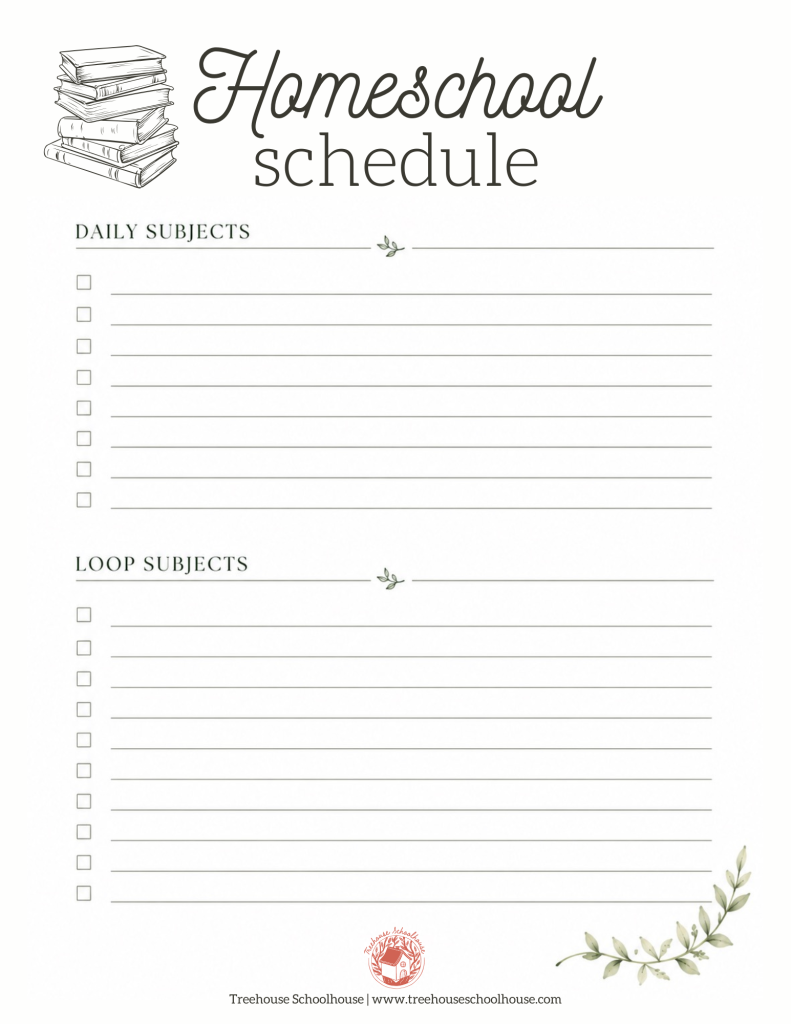
Ready to create your own loop list for your homeschool? Use the Looping Schedule Template below to create your own loop schedule. Save and print the free Loop Scheduling Template for your homeschool planning below.
Homeschooling should fit into your life, not the other way around. I hope this gives you some ideas for adding in all the things you love without added stress or overwhelm. Share your thoughts in the comments below.