
“History is who we are and why we are the way we are,” said historian David McCullough.
As we offer children a rich education and nurture their own curiosity and love of learning, history is a wonderful way to teach children about the world and how past events influence modern-day life. As children make connections in history, they have the opportunity to solidify what they learn, build a framework for a lifetime of learning, and make an individual connection to historical events.
In this blog post we are sharing about the practice of timelining and how to create a history timeline book for children to curate their own collection of historical events. This is a practice that children can do over several years, recording what they learn about historical figures and events they encounter in their homeschool studies.
In this blog post:
- Charlotte Mason homeschool method: Using timelines to make connections
- How to create a history timeline notebook
- Frequently asked questions about creating a history timeline book
Charlotte Mason homeschool method: Using timelines to make connections

“Education is the science of relations,” Charlotte Mason wrote in School Education. As children begin formal academics, one goal of education is for them to make connections between past and present-day events they learn about.
A Charlotte Mason education encourages students to engage with real life as they learn, offering a rich feast of knowledge and meaningful experiences instead of just dry textbooks and facts. This is done by offering studies in nature, poetry, living books, classical art, and encouraging children to restate what they know through the practice of narration.
A Charlotte Mason education assumes that a child’s history studies can be just as meaningful. Just as a living book is a text written by a person with a passion for a subject, children should learn about history to develop a meaningful understanding of past events that connect with their own lives. One helpful practice is for children to create their own history timeline, something they can gradually build alongside other learning.
Charlotte Mason encouraged children to create a Book of Centuries, a specific method for children to curate and record elements of their learning in a book organized by time periods. By collecting important moments from history and adding them to a timeline, this practice is designed to help children create a personal understanding of history. Children create a timeline by weaving together historical figures, events, or other ideas they learn about and list them with the time period the person lived or the event happened. As they add more entries over time, they have a simple way to see and explore connections of different moments in time.
For example, a child studying classical music might add the composer or musical style to their timeline. Mozart’s birth, in 1756, can be added alongside other events of that time, like the signing of the Declaration of Independence in 1776. A child might add the birth date of their favorite author, or their own birthday, so they begin to grasp an order of world events and how they fit into that picture. Building a timeline gives detail, color, and flavor to these moments in history, making them more meaningful and easier to recollect.
The Charlotte Mason Book of Centuries is a visual timeline in a book format, where each two-page spread covers 100 years. As children learn new things, they can simply flip to that timeframe in their Book of Centuries and mark important events they learn about, either by writing short descriptions or drawing pictures.
Creating timelines helps children understand what they learn more deeply as they make connections and develop a better context for what they learn. It also helps solidify their knowledge, slowly developing a visual aid of how world events flow into one another, and creating a simple way to pull a wide variety of subjects together.
How to create a history timeline notebook

In my homeschool, we practice timelining by giving each child their own History Timeline Notebook. This practice helps my children pull out meaningful things they learn about and creates a visual guide of what they learn and how historical events flow together.
We use this pre-printed History Timeline Book, which uses a continuous timeline throughout the entire book. It includes time periods for Ancient Times (6000 BC – AD 499), the Middle Ages (AD 500 – AD 1599), Early Modern History (AD 1600 – AD 1849), and Modern History (AD 1850 – AD 2099). The timeline pages are printed on graph paper, so my children can practice organizing what they learn and neatly recording events that are interesting and important to them.
We use this alongside nature study and holiday studies, where we regularly read about poets and artists. We have also loved using this with our history curriculum, Story of the World, cutting and pasting pictures of famous artifacts and historical figures so each child can visually see how things fit together. Last year, we learned about Ancient Times, studying Ancient Egyptian civilization, the first nomadic people, Cuneiform writing, the history of the alphabet, and the history of the Jewish people.
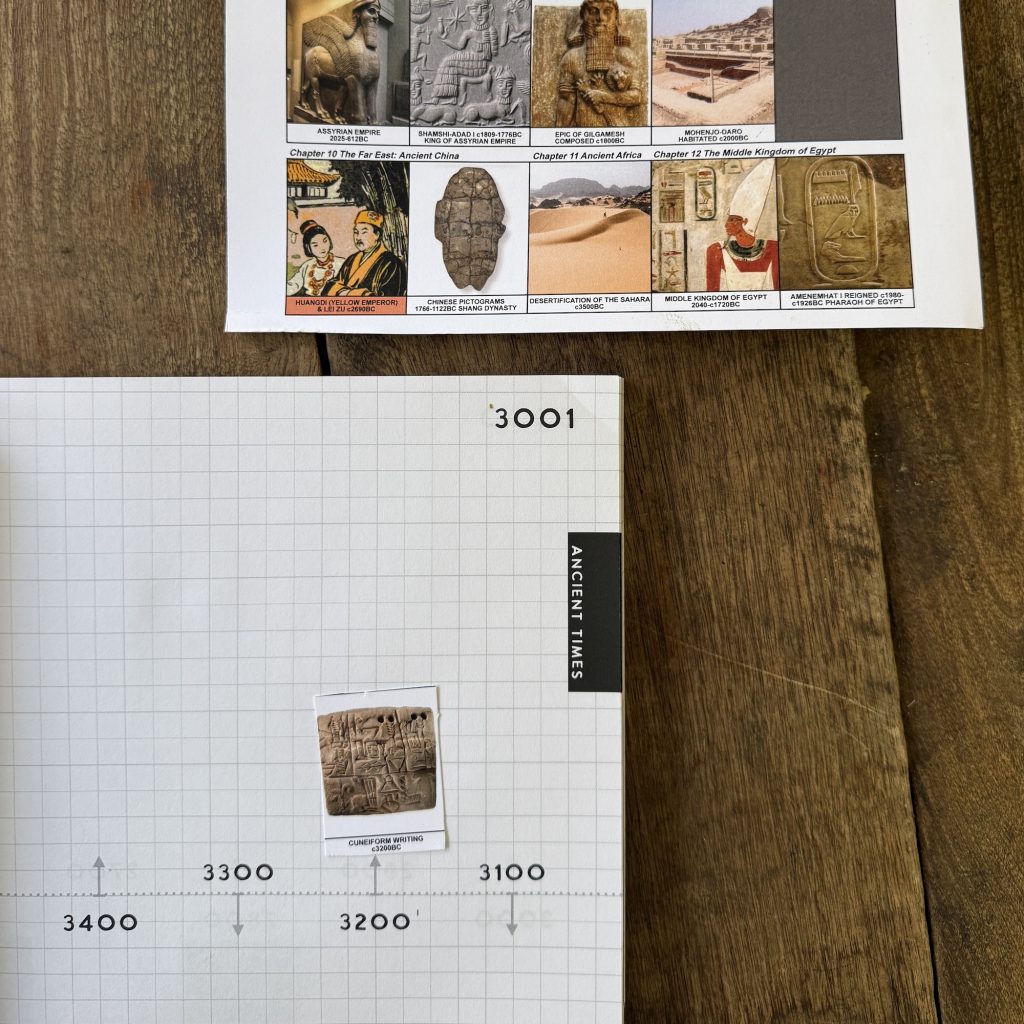
This year, we are studying the Middle Ages through Story of the World, Volume 2, and are learning about the fall of the Roman Empire and the Renaissance period. Instead of having separate, unconnected studies, building timeline notebooks gives each child a way to organize what they learn into personal, chronological booklets that they can refer back to and continue to build over several years, weaving what they learn into a cohesive record of people and places in history. As we continue our learning with another year of curriculum, we will continue adding entries to our timeline books. We normally do this every other week.
Their timeline notebooks are also a personal way of remembering favorite things from our studies alongside important events in our lives, like birthdays or other milestones. Creating detailed timelines helps children understand the scope of history and see how one event flows into another, or identify the historical periods they don’t know as much about. Children may discover that many of their favorite things have a common thread, like being born out of the same region, style, or time period, or they may learn they have an eclectic love of different things across different points in history.
We love using a timeline notebook, but you can also do this practice by letting children build a timeline on a wall that you use for a certain time period you are studying. Simply line up and date blank pages of paper, attach them together, and let children fill in the timeline as you learn. You could let children creat their own, or you could collaborate and add things as a family.
Here are some other ideas of things to add to your timeline:
- Historical events, like the rise and fall of empires, wars, treaties, milestones, and more.
- Historical figures, like leaders, explorers, and everyday people.
- Notable Biblical history events.
- Biographical figures, like the birthdates of influential authors, poets, and artists.
- Works of art, like architecture, sculptures, paintings, novels, or classical music.
- Historical artifacts.
- Personal timelines, like family birthdays.
- Time periods and genres (art, music, and literary styles).
Frequently asked questions about creating a history timeline book

The practice of creating a history timeline is a simple and flexible practice that can be tailored to any age level. Here are some tips and tricks to help you get started.
- At what age do you recommend children begin creating a history timeline notebook? Age 5-6, when children have some reading ability and handwriting skills. For young children, we mostly add pictures to their timeline by cutting and pasting.
- What is your favorite book to use for creating a history timeline notebook? We love this pre-printed History Timeline Notebook from Amazon.
- Where do you find those square photos to cut and add to your timeline books? We use these pre-printed Timeline Cards that coordinate with Story of the World, which we can cut and paste into our timeline books.
- How often do you make entries into your timeline notebooks? We take a moment to do this every couple of weeks, reflecting on what we learn and asking kids to add their favorite things.
- What do you require children to write in their entries? We keep it simple by just adding a picture and writing the name of the person or event.
- Should I buy a pre-printed timeline book or make my own? You can definitely make your own (there are tons of tutorials online), but I prefer to use a pre-printed version that is already bound and has the time periods marked for convenience and to use for several years.
- How do you avoid a timeline page looking messy or cluttered? You can try making entries in pencil, using rulers, or writing entries on copy paper first before adding it to your timeline notebook. You could also have a child make entries on a separate paper that you cut and paste into the notebook.
Do you create history timeline notebooks in your homeschool? Share your favorite ideas in the comments below.


