Our family recently traveled to Virginia to spend four days exploring the Jamestown Settlement, Colonial Williamsburg, and Yorktown Battlefield. In this blog post, I am sharing our itinerary and what we did at each site, including how we toured historical sites in chronological order.
My children, ages 6-13, love learning about history, and over the years we have enjoyed reading books about the colonial era, the Pilgrims, and what colonial life was like, so we were all excited to visit historical sites together.
I love any opportunity to make real-world connections to our homeschool studies. We previously learned about the First Thanksgiving with A Treasured Thanksgiving, reading about the Wampanoag tribe and cooking history-inspired recipes in the Thanksgiving unit study, so we were eager to learn more about the Pilgrims, the American Colonies, and the Revolutionary War and see some of these sites in person.
In this blog post:
- Our homeschool family itinerary for Jamestown Settlement and Colonial Williamsburg
- What we did in Historic Jamestown
- Our experience at Colonial Williamsburg
- How we toured the Yorktown Battlefield
- Where we stayed, restaurants, and other travel tips
Our homeschool family itinerary for Jamestown Settlement and Colonial Williamsburg

Here is our itinerary for our recent family trip to Virginia to visit Colonial Williamsburg and other historic sites in this area. This area is also called the Historic Triangle, referring to Jamestown, Colonial Williamsburg, and Yorktown.
We spent four days exploring this area, visiting each historic site in chronological order. Here is how we structured our trip, and how much time we spent in each location.
- Day 1: Jamestown Museum (6 hours)
- Day 2: Jamestown Glasshouse (1 hour), Jamestown Settlement (4 hours), and Colonial Williamsburg (1 hour)
- Day 3: Colonial Williamsburg (6 hours)
- Day 4: American Revolution Museum (4 hours), Yorktown Battlefield indoor exhibit (1 hour), Yorktown Battlefield outdoor fields (1 hour)
When we visit museums, we try to take our time at each location and make the most of each stop. We will usually watch the videos and read the different signs and presentations. My husband enjoys reading the signs and explaining the interesting parts to our children. This can be tiring, so we definitely take breaks for meals and rest throughout the day. We also love doing any Junior Ranger activities we come across when traveling.
What we did in Historic Jamestown

We started our trip at the Jamestown Museum and quickly realized that to understand it, you need to visit both the museum and the historic settlement. Both sites are interconnected, but offer very different experiences. We spent two days exploring the Jamestown Museum, Historic Settlement, and 1608 Glasshouse.
Jamestown, Virginia, was settled in 1607 and was the first lasting English settlement in North America. The Jamestown Museum is a good place to start because it teaches about the Native Americans, how the Jamestown settlement was started, and what daily life was like in the 1600s. The first thing we did was watch a film about Jamestown, followed by indoor exhibits. This gave my kids a fuller picture of what daily life was like for the settlers.
My kids loved seeing the hands-on demonstrations and activities at the Jamestown Museum. We walked through homes recreated to resemble the homes Native Americans would have built at Paspahegh Town. Costumed actors demonstrated how people made and used bone tools, navigated at sea, worked with ropes, carved out trees as canoes, and practiced blacksmithing. The kids tried new skills, looked at tools up close, and were close enough to talk with the actors and ask questions. We are always impressed with learning about how things were made before modern technology. Trades required incredible skill and years of apprenticeship to master.
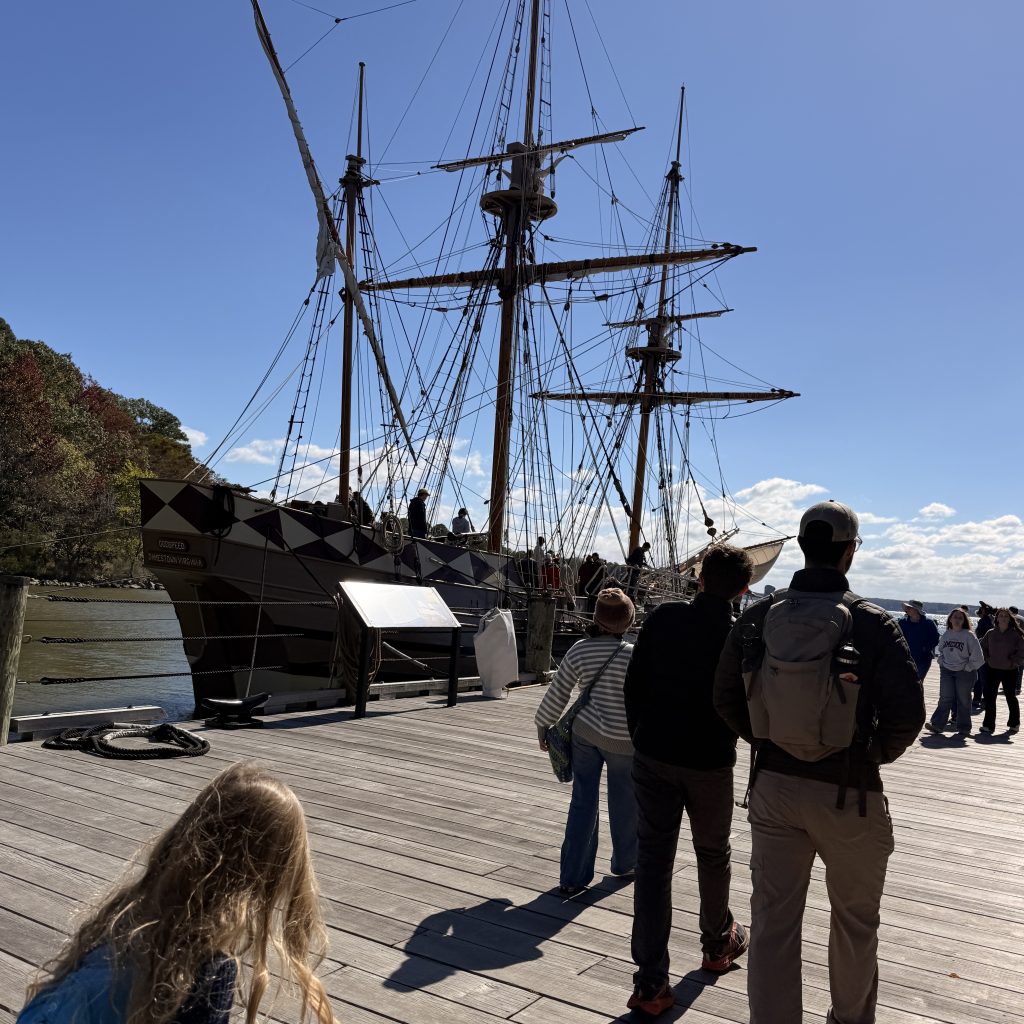
We also walked aboard the ships docked in the James River: the Susan Constant, the Godspeed, and the Discovery. Walking through the tight spaces on the ships allowed my kids to experience what the settlers’ journey across the ocean might have felt like. It’s one thing to read about a voyage in a book; it’s another to stand on a ship and picture being far from home, with an unknown world ahead.
Next, we visited the historic site at the Jamestown Settlement, where we could walk the ground where Jamestown once stood. Jamestown was abandoned at the end of the 17th century, as early Pilgrims and colonists moved to other cities, but you can still visit the site where it once stood. Jamestown is famous for being the place where Pocahontas and John Rolfe were married.
Jamestown Museum helped us understand the larger story, and the Jamestown Settlement gave the story a sense of place. Jamestown is also part of Colonial National Historic Park, so the kids enjoyed taking part in the Junior Ranger program while we were there.
One of our favorite parts of the visit was the archaeology museum at the Jamestown Settlement. This site is also an active archaeological dig. We saw uncovered artifacts like tools, toys, bones, and so many other pieces of daily life. The children were fascinated by the idea that ordinary objects could survive for centuries and help tell the story of the people who once lived there. We were able to see archaeologists at work, sifting through the ground. We were so impressed by watching history still being uncovered, piece by piece.

The Jamestown Glasshouse was another fascinating stop. We watched glassblowers shape molten glass into beautiful pieces, and the children could see the process up close. We walked through the site of the former Jamestown Glasshouse and saw remnants of it. We learned how glassblowing was an important early industry in the settlement, not just an art form. We brought home a glass ornament as a keepsake and a reminder of what we’d watched being made.
Historic Jamestown Quick Travel Guide

Location: Williamsburg, Virginia
Website: https://www.jyfmuseums.org
Pricing: Adult $21, Child Age 6-11 $11, Child 5 & Under Free, Military Free
Key Learning Themes:
- Jamestown Settlement
- Powhatan Native Americans
- English Colonists in the 1600s
- Journey from England to North America
Must-See Highlights:
- Replica ships docked at the James River
- Jamestown Rediscovery archaeological site
- Jamestown Glasshouse
Our experience at Colonial Williamsburg

We stopped in at Colonial Williamsburg on the second day of our trip and spent the entire next day exploring this living history museum. We loved it.
Colonial Williamsburg was founded in 1632 and became the official colonial capital of Virginia in 1699. Today it is a living-history museum with hundreds of restored or recreated buildings and actors who reenact 18th-century life. The actors wear traditional colonial costumes and speak with colonial accents and vocabulary. This period in history takes place about a century after the First Thanksgiving and the stories we studied in A Treasured Thanksgiving.
Before we went, I assumed Colonial Williamsburg would include a more traditional museum that would connect what we learned about Jamestown to Williamsburg. Instead, Colonial Williamsburg is laid out like a town. To explore it, you need to walk its streets, step into historic buildings, watch tradespeople at work, and meet interpreters who bring different parts of 18th-century life to the present. It’s immersive, but the experience felt a little scattered as it was spread across the area rather than organized around one main exhibit. I’ll admit we were a little disappointed we didn’t find a central place that connected the story from Jamestown to Williamsburg. We had to put the pieces together on our own as we explored.

One thing I appreciated about Williamsburg was the schedule of activities happening throughout the day. We structured our day around the performances and tours we wanted to see, then spent the time in between wandering the streets and stepping into shops. More than 20 historic trades are represented in the Historic Area, from wigmaking and blacksmithing to woodworking and gunsmithing. Costumed interpreters work in the shops, making the town feel lived in. Shops open to visitors have a Grand Union flag posted outside to show whether or not you can go in. Inside, interpreters are demonstrating their trades while talking about it, answering questions, and letting you see and touch things up close.
We toured the Governor’s Palace, including the kitchen, where interpreters were actually cooking, and then wandered through the garden maze behind the house. We also joined “Talk of the Town 1774,” watched a music performance, caught a couple of short skits, and saw the Fifes and Drums march through town. There was always something to look for or listen to, but plenty of room to explore at our own pace, too.
You can walk through the Historic Area or use the shuttle buses to get between stops. Either way, wear comfortable walking shoes. We covered a lot of ground!
Colonial Williamsburg Quick Travel Guide

Location: Williamsburg, Virginia
Website: https://www.colonialwilliamsburg.org/
Pricing: Adult (13+) $37.50, Child Age 6-11 $10, Child 5 & Under Free
Key Learning Themes:
- 18th-century daily colonial life
Must-See Highlights:
How we toured the Yorktown Battlefield
Our last stop was the Yorktown Battlefield. This is a Revolutionary War battle site where the Siege of Yorktown took place in 1781. This battle was the final major land conflict of the Revolutionary War, won by George Washington and the Continental Army, which forced the British army to surrender.
First, we visited the American Revolution Museum at Yorktown. It’s small, but we enjoyed watching the film and seeing artifacts, including the actual tent used by George Washington!
Then we drove the Yorktown Battlefield’s self-guided tour route, stopping along the way to get out and walk the ground where the siege unfolded. The route has six stops, including the British defense lines, the Grand French Battery, and Redoubts 9 and 10, where French and American troops attacked the British defenses. At Surrender Field, we could picture the moment the British forces laid down their arms. The Moore House is the site where army representatives met to discuss the terms of surrender.
Moving through the landscape helped us connect the story with the actual places where it happened. The battlefield is spread out, so the driving tour makes it easy to explore at your own pace, pausing to read the signs and walk around at each stop.
Over the last couple of years in our homeschool, we have mostly studied ancient history in our homeschool curriculum. After this trip, we are looking forward to learning more about the colonial times and the Revolutionary War, and we are considering reading living books like Carry On, Mr. Bowditch, and other stories that take place during this time period.
Yorktown Battlefield Quick Travel Guide
Location: Yorktown, Virginia
Website: https://www.nps.gov/york/index.htm
Pricing: $15 per person
Key Learning Themes:
- Revolutionary War
- George Washington
- Final land engagement of the Revolutionary War
Must-See Highlights:
More family travel tips for Colonial Williamsburg

Here are a few more details about where we ate and where we stayed on this trip.
We purchased the America’s Historic Triangle Ticket, which gives you access to five historic sites, including all of Colonial Williamsburg’s historic sites, trade shops, and select events at the Art Museums for five consecutive days from the first date of use. You might also check the calendar for Colonial Williamsburg Homeschool Days, which happen a couple of times a year.
We stayed at The Colonies at Williamsburg, which was a good fit for our family of six. Our room had a full kitchen, so we made breakfast at home each morning, packed lunches or came back for a midday break, and cooked dinner at home most of the nights we were there. The resort also had an indoor pool and an arcade. The arcade was small, and the rooms themselves weren’t the most beautiful place we’ve stayed, but the location worked well for us. We were mostly there to eat and sleep.
For one lunch out, we picked up sandwiches at The Cheese Shop in Merchants Square and ate at the tables along Duke of Gloucester Street (“DoG Street” to the locals). It was delicious, and such a lovely place to sit and take in the historic area. We also stopped for coffee and pastries at Hohl, an Australian-style café near Colonial Williamsburg. Highly recommend!
Here are more photos from our trip, if you’d like to see.


Have you toured Colonial Williamsburg? Share your experience in the comments below.
Lyndsey Mimnagh is a homeschool mom of four, founder of Treehouse Schoolhouse, and lifelong believer in the power of stories, play, and creativity. Lyndsey lives in North Carolina with her husband and children and can usually be found reading aloud, crafting, hiking, or enjoying good espresso. Connect with her on Instagram @treehouse_schoolhouse.